In the 2025 financial year, Kombiverkehr KG maintained a consistent strategic focus on further developing digitalisation and modernising its IT systems. The aim remains to achieve a sustainable increase in the efficiency and quality of operational processes within its core business, whilst continuously enhancing customer service.
The technological basis of the company’s processes continues to be formed by the in-house developed systems CAT (Capacity and Train Management) and KOBRA (Kommerzielle Bearbeitung und Buchung von Aufträgen). These systems manage key business processes such as order processing, transport control and monitoring, invoicing and accounts payable. The core systems are supplemented by specialised software solutions and third-party applications, which ensure a digital and seamless process landscape across all areas of the company.
In 2025, particular emphasis was placed on the technical modernisation of the company’s own applications. In addition to the introduction of new, more user-friendly interfaces, the underlying system architectures and databases were also comprehensively overhauled and adapted to current technological requirements. These measures further improved the performance, stability and scalability of the systems. Following a project phase in 2025, the myKOMBIVERKEHR portal was expanded at the end of June 2026 to include a new emissions accounting application. The KV 4.0 data hub, marketed in collaboration with other companies, was again very well received by the industry in 2025 and is becoming increasingly established. The KIBA project, which focused on artificial intelligence for load optimisation, was completed.

The digital transformation in the field of IT solutions for intermodal transport is gathering pace. Our KV 4.0 data hub, which we developed with partners and market jointly, is gaining increasing acceptance in the market. Over 30 companies have already joined the system and are relying on this forward-looking solution to ensure optimal connectivity between all stakeholders in the intermodal transport chain. A further 55 companies have expressed an interest in our system. This clearly demonstrates that KV 4.0 is right on trend and offers genuine added value for modern, connected processes – particularly in relation to timetables, bookings, tracking and terminal slots.
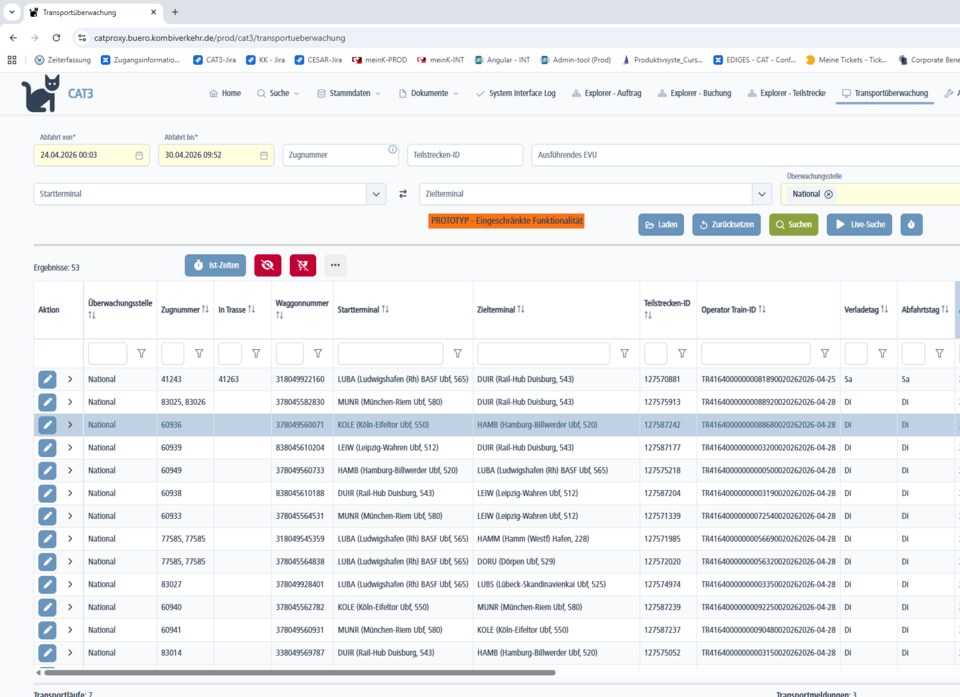
Kombiverkehr is continuing to drive forward the modernisation of its central IT system, CAT. The application is used by our own staff as well as by personnel at our Kombiverkehr agencies at the terminals. Significant progress was also made in the 2025 financial year, strengthening stability, security and future-proofing.
Due to outdated technologies and the phasing out of manufacturer support, a renewal was necessary. The aim is to establish a state-of-the-art technological foundation and more efficient development and operational processes. In future, a current programming language, modern web technologies, new frameworks and OAuth2-based authentication will be used to improve maintainability, security and user-friendliness.
The transition is taking place in stages. In parallel with the existing system, a new CAT3 service is gradually taking over functions and providing a new web interface. This ensures that ongoing operations remain unaffected whilst further development progresses. All new CAT interfaces are scheduled to be successfully rolled out by the end of 2026.
Among other things, a new online booking system (“Easy Booking”) is planned for the coming years. Overall, the project enhances CAT’s capabilities and specifically tailors them to the requirements of a digitalised logistics environment.
Together with the Hamburg-based software company shipzero, we have successfully implemented a joint project to account for transport emissions. Following an intensive design, development and implementation phase during the 2025 financial year and in recent months, the new IT solution officially went live at the end of June 2026. shipzero’s methodology is certified by the Smart Freight Centre, is fully aligned with the international Global Logistics Emission Council Framework V3 and complies with the ISO 14083 standard.
With the new application, we provide our customers with up-to-date and precise emissions data for every transport operation carried out by Kombiverkehr within 24 hours of the transport’s completion, thereby meeting the increasing demands for reporting. The emissions data newly integrated into the central order management system CAT is displayed to the company’s customers via a web service on the myKOMBIVERKEHR portal and is also available for download for further data selection. For the visual presentation of emissions savings, portal users also have the option of integrating their own company logo and generating an emissions certificate as a PDF document.
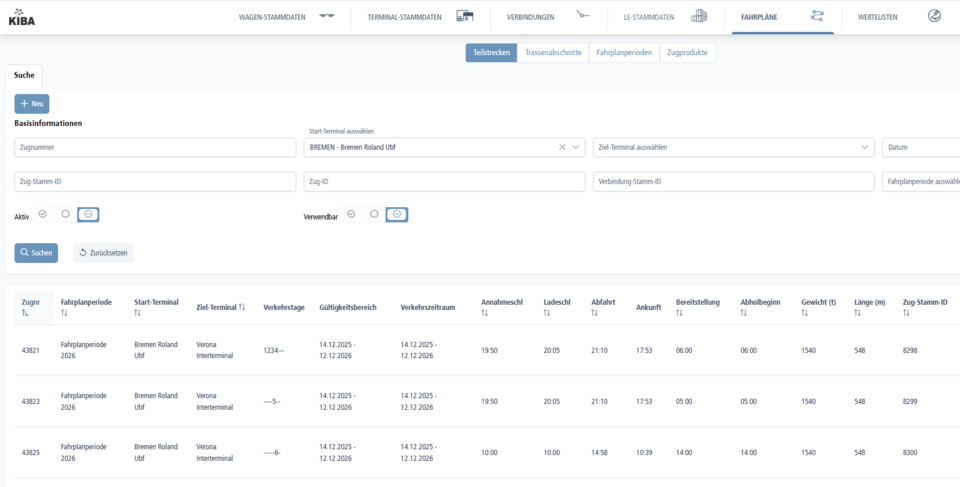
In September 2025, another project funded by the Federal Ministry of Transport – KIBA (Künstliche Intelligenz und diskrete Beladeoptimierungsmodelle zur Auslastungssteigerung im Kombinierten Verkehr) – was successfully completed. As part of the project, Kombiverkehr played a key role in developing methods for network optimisation and train loading planning, the results of which can be integrated into the project partners’ existing systems.
The models developed enable significantly more efficient use of train capacity by making optimal use of load weight and length. At the same time, they help to reduce crane movements and transhipment operations at the terminals. Through the automated consideration of numerous influencing factors and AI-based volume forecasts, load units are distributed in such a way that trains are utilised to the fullest extent possible and shipments reach their destination with short transit times and minimal transhipments.
For users, the complexity remains in the background: booking enquiries are processed automatically and converted into optimal transport solutions by the optimiser. In doing so, the system not only draws on current enquiries but also takes into account forecast shipment volumes and regular customer traffic to plan capacities proactively.
To date, the calculations have been based on historical test data. The next step will be to validate the models using current operational data in order to demonstrate their added value compared to the previous manual planning process. The aim is to significantly reduce the planning workload for around 700,000 to 800,000 loading units per year, whilst further increasing efficiency in combined transport.