Handling volumes at the terminals remained at an acceptable level despite the global crisis. Capacity at some major handling terminals in Germany and Europe is largely utilised, assuming average traffic volumes and normal operations.
Kombiverkehr holds stakes in 17 terminal companies, which form the access points to the company’s network.
Kombiverkehr holds a 12.5 % stake in Deutsche Umschlaggesellschaft Schiene-Straße (DUSS) mbH. In 2025, the company handled 1.9 million loading units, representing a 5 % increase on the previous year (1.8 million). DUSS operates 24 domestic terminal sites.
The Duisburg-Ruhrort Port terminal, owned by Planungsgesellschaft Kombinierter Verkehr (PKV), serves as a central hub for Kombiverkehr within the national and international rail network. At the PKV site, the operating company DUSS reduced handling volumes by 13 % to 144,711 loading units in the reporting year (previous year: 166,475).
Neuss Trimodal GmbH handled 115,667 loading units in the 2025 financial year (previous year: 143,736). To drive forward digitalisation projects, a funding application was submitted for replacement investments.
At the Kombi-Terminal Ludwigshafen GmbH (KTL) facility, jointly operated by BASF SE, Kombiverkehr and other partners, 288,020 loading units were handled in 2025, representing a 5 % reduction on the previous year (304,332). Plans to expand the terminal are progressing and include, for example, an extension of the crane runway and increases in capacity.
Nürnberg Hafen Tricon handled a total of 197,364 loading units in 2025 (previous year: 194,918), representing an increase of 1 %. Kombiverkehr held a 25 % stake in the company and sold < by Roland Umschlagsgesellschaft Bremen mbH & Co. KG, achieved a higher handling volume last year with 104,626 loading units compared with the previous year (99,143).
Eurokombi Terminal GmbH at the Port of Hamburg recorded an 8 % increase in handling volume to 453,702 loading units in the past financial year (previous year: 419,588).
Rostock Trimodal GmbH recorded a 2 % decline in handling volumes to 109,829 loading units (previous year: 111,772).
KombiPort Kiel GmbH operates handling facilities at Kiel’s Ostuferhafen and Schwedenkai. Both sites serve as hubs for transport to Scandinavia as well as the Baltic States. At 8,529 units, the number of cargo units handled is 34 % below the previous year’s figure (12,903). This is partly due to the fact that no cargo was handled at the Ostuferhafen in Kiel in 2025.
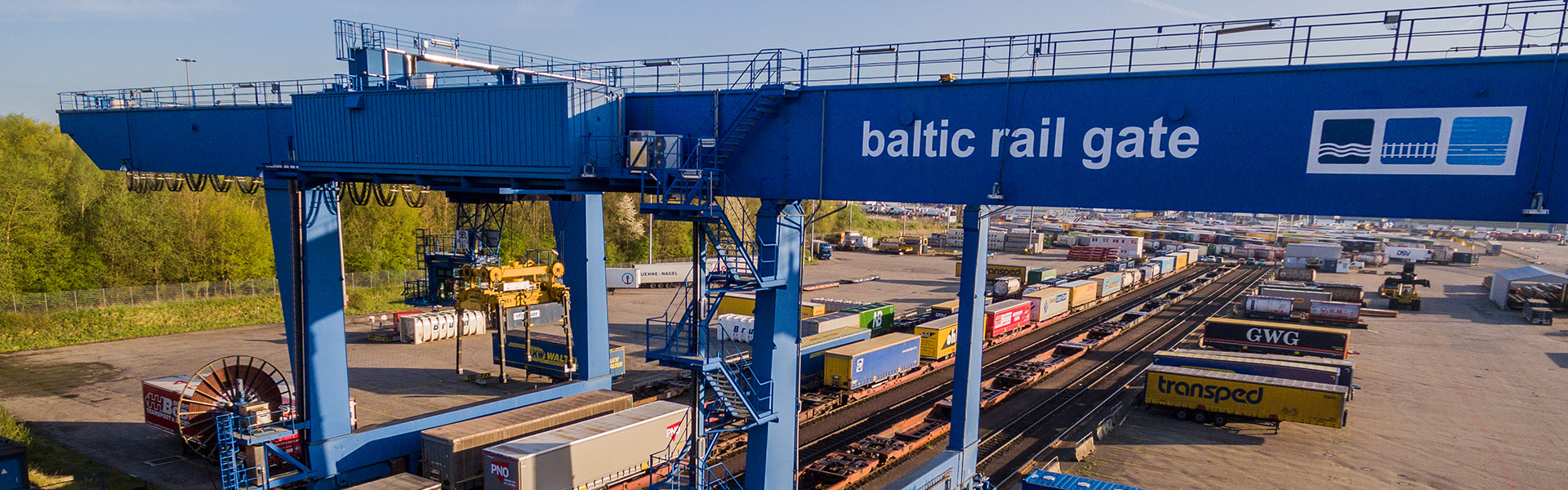
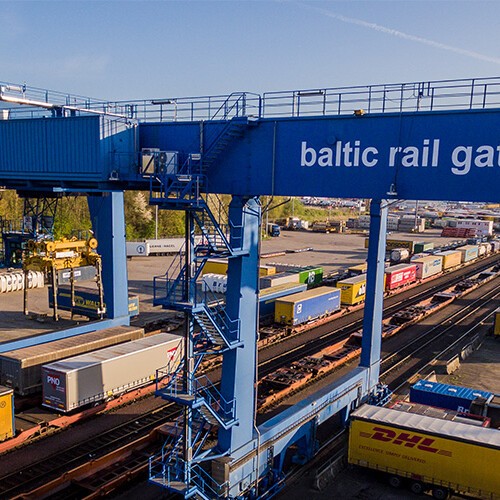
Baltic Rail Gate GmbH in Lübeck increased its transhipment volume to 129,221 loading units in the past year (+4 %, previous year 123,943).
The MegaHub Lehrte GmbH high-speed transhipment facility near Hanover, which is connected to the combined transport network, handled 71,416 loading units in 2025 (previous year: 72,827), representing a 2 % decline.
Kombiverkehr holds a stake in Südwestfalen Container Terminal GmbH, which operates a transhipment facility at the Kreuztal terminal site covering a total area of around 18,500 m². Operations commenced in May 2019. In 2025, 861 loading units were handled (previous year: 1,101).
At the end of 2022, Kombiverkehr established Kombiterminal Mortara S.r.l. as the operating company for the transhipment terminal in Mortara (Italy). The terminal has a transhipment capacity of 70,000 TEUs. Operations commenced on 1 January 2023, and the terminal handled a total of 38,010 loading units in 2025 (previous year: 33,980).
At the end of 2023, a 10 % stake in Rail Hub Milano S.r.l., Melzo, was acquired. The site offers additional opportunities to expand Kombiverkehr’s network in northern Italy. A total of 191,730 loading units were handled in the reporting year (previous year: 180,513).